
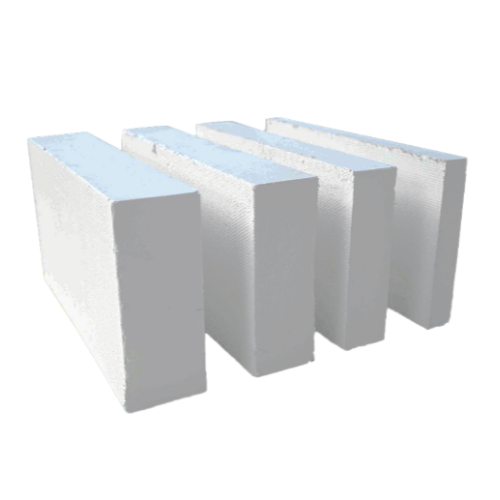
Product Introduction:
Calcium silicate board for cement plants generally refers to the calcium silicate board used in parts such as decomposition furnaces, preheaters, tertiary air ducts, kiln head covers, coolers, and flue chambers. Since it is used in cement plants, it is called calcium silicate board for cement plants. The service temperature of calcium silicate board for cement plants is generally 1050℃. It features high strength, good toughness, and excellent insulation.
Parameter Introduction:
Operating temperature: ≤1050℃
Density: ≤230kg/m ³
Compressive strength: ≥0.65Mpa
Flexural strength: ≥0.33Mpa
Linear shrinkage rate: 2%
Thermal conductivity: ≤0.065w/m.k
Asbestos content: Asbestos-free
Advantages and features:
High strength: Calcium silicate boards used in cement plants feature high strength. The high strength not only reduces the loss during transportation but also minimizes the problem of fragmentation loss during construction.
Good toughness: Calcium silicate boards used in cement plants have excellent toughness. Good toughness can ensure that the product is not prone to deformation in high-temperature environments, maintaining overall stability and thus providing a guarantee for usage safety.
Good insulation: The calcium silicate board used in cement plants has a very low thermal conductivity. A low thermal conductivity can reduce heat conduction and loss, thus providing excellent insulation performance.
High-temperature resistance: The calcium silicate board used in cement plants can be used at temperatures up to 1050℃. Its performance remains unchanged in high-temperature environments, thus it has strong high-temperature resistance.
Process Introduction:
The main raw materials for calcium silicate board used in cement plants are calcium hydroxide and quartz sand. The raw materials are ground and purified, and then reinforcing fibers are added and reacted in a reactor. After the reaction is successful, the raw materials are injected into a press to be pressurized and formed. The formed products need to be pulled into a 60-meter-deep tunnel cellar for drying. After about a week of drying, the finished calcium silicate board for cement plants is made.