
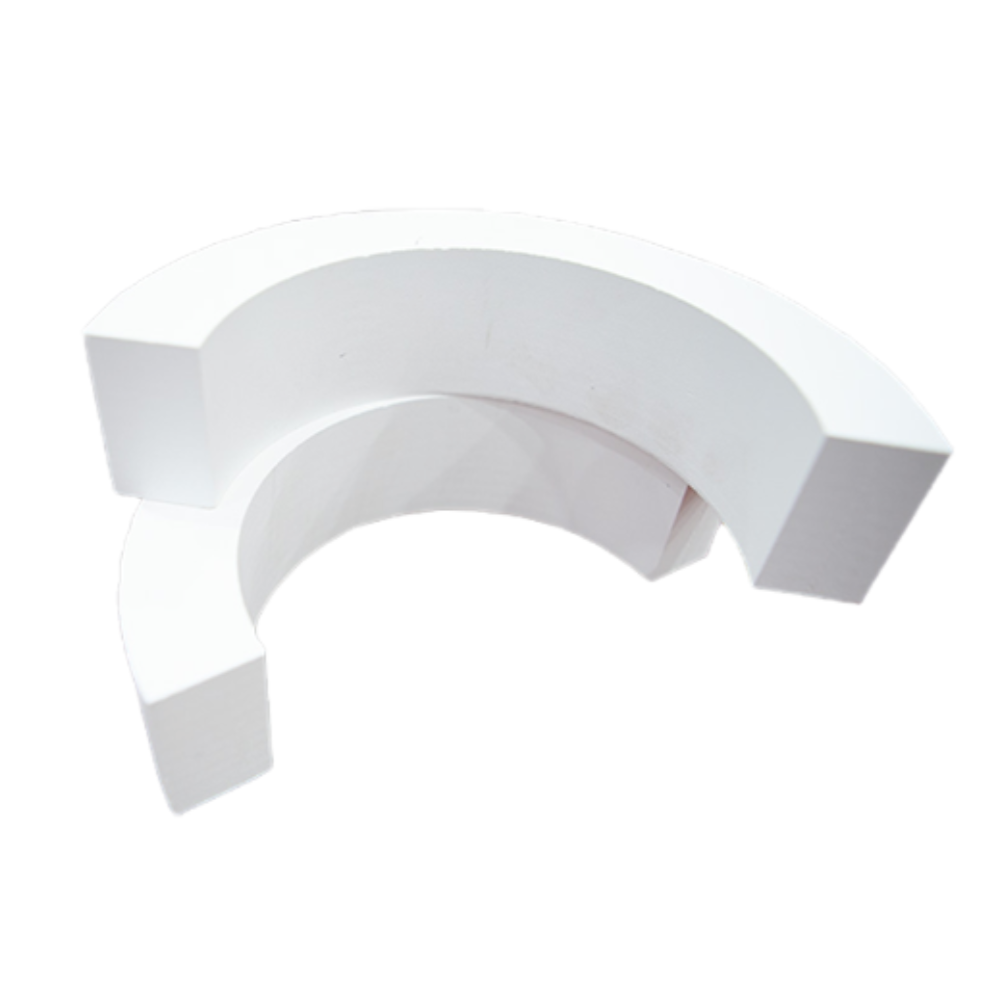
Features:
Calcium silicate arc-shaped plates are mainly made of calcium hydroxide and quartz sand. The specific size and curvature can be customized according to the usage requirements. Calcium silicate arc-shaped plates and calcium silicate plates have the same advantages, such as high strength, no deformation after long-term heating, and long service life.
Technical indicators:
| Physical Index | Unit | Value |
|---|---|---|
| Bulk Density (max.) | kg/m³ | 200-230 |
| Flexural Strength (min.) | Mpa | ≥0.4 |
| Compressive Strength at 5% Deformation (min.) | Mpa | ≥0.8 |
| Linear Shrinkage (%) (1000℃*3h) | % | ≤2 |
| Thermal Conductivity (100℃) (min.) | w/m.k | ≤0.069 |
| Service Temperature (max.) | ℃ | 1050 |
Advantage:
1.calcium silicate arc plate using a new process, relative to the old process of calcium silicate arc plate itself higher strength, less loss during construction, reduce the loss cost.
- The strength of calcium silicate arc-shaped plates has been enhanced, which has greatly increased their service life and met the usage requirements of multiple industries.
- Calcium silicate arc-shaped plates have high flexural strength and will not change their original shape even after long-term exposure to high temperatures.
- The thermal conductivity of calcium silicate arc-shaped plates is lower than the national standard, and their insulation performance is better.
Production process:
The processing flow of calcium silicate arc-shaped plates: First, the raw materials are ground into powder. After processing, the powder is filtered to ensure the fineness of the raw materials. Then, reinforcing fibers are added. After reacting in a reactor, it is sent into a mold for pressure molding. Finally, it is dried in a tunnel cellar.
Application :
Calcium silicate arc-shaped plates have a wide range of applications, mainly including: the metallurgical industry, the cement industry, the petrochemical industry, the glass industry, the power industry, etc.